
Your cart is currently empty!

USDCAD Carry
Long USD/CAD Carry opportunity, or will Canada respond ‘robustly’?
The Trump administration has declared it will enforce tariffs of 25% on imports from Canada. However, after his inauguration, Trump held back on going forward with his day 1 tariff execution. On the day of his inauguration, the Canadian dollar tanked as much as -1.5% against the US dollar on the day, while closing a mere -0.11% lower than the day’s opening.

Imports
The first question might be: why tariffs on Canada (and Mexico), but not Europe or China? First and foremost, these four regions share the largest share of US imports. Mexico, Canda and China are in the top 3, carrying 16%, 15% and 14% respectively of US imports, a total of 45%. Include Europe (24%) and we arrive at 69% of US imports. Tariffs on these four regions mean that the US will receive an immense amount of money.
Contrary to 69% of US imports, the Trump administration chose to target only Mexico and Canada of those four regions, counting a total of 31% of imports, still almost a third. China, for example, doesn’t have a ‘good’ relationship with the US like Canada and Europe have. Therefor, China might decide to stand behind its currency and respond to tariffs by increasing prices. This will in turn result in higher consumer prices in the US, as importing corporations will inevitably increase consumer prices. I’m describing threatening inflation, which no one is waiting for.
How will Canada respond to tariffs? Will they back up their currency? Some say that the Canadian government will impose retaliatory tariffs of 25% on imports from the US. This won’t be enough, as the US imported $430 Billion from Canada in 2023 and Canada imported ‘only’ $277 Billion from the US in 2023. Others say that Trump declared a full on trade war with Canada and that Canadian corporations will use every tool available to protect their economy.

Will history repeat itself?
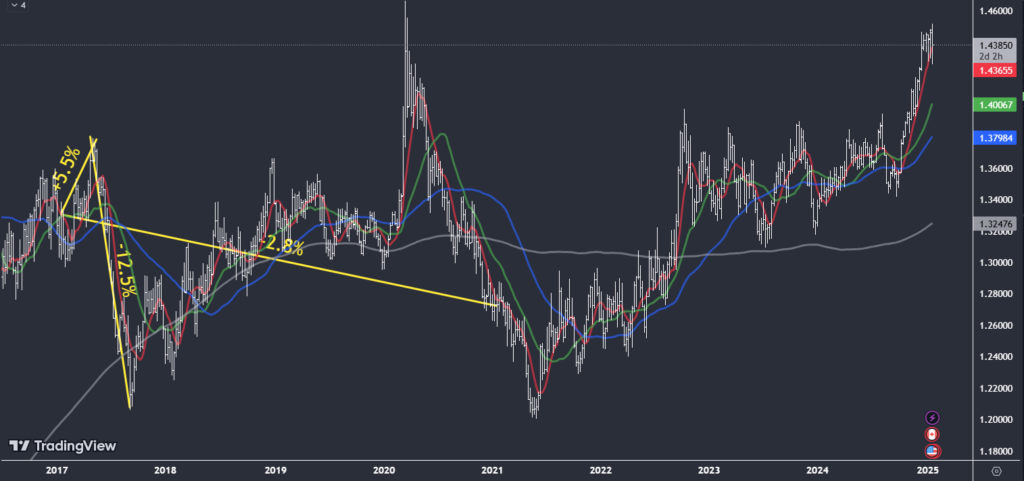
Canada has been here before, though. The previous presidency of Trump promised tariffs on Canada as well, but eventually Canada got away with a free trade deal. The Canadian dollar sunk 5.5% in the first five months after Trump’s inauguration. However, from the high in may 2017, the Canadian dollar strengthened by a staggering 12.5% in four months. Eventually, the Canadian dollar only lost 2.8% of value in Trump’s first presidency. The volatility in 2020 had nothing to do with tariffs of some sort.
Looking at a more macro-economic point of view for the longer term, let’s look at three key components of both economies: unemployment rate, inflation rate and interest rate. I will also summarize the expectation of the interest rate according to central bank policy.
Unemployment Rate
Both the US and Canada have had unemployment at historically low levels. However, the unemployment rate of Canada has risen more steeply than that of the US over the past three years. Canada can only do so much to strengthen their currency, and by doing that it might hit the overall economy. To prevent unemployment from getting out of hand, Canada might decide to stimulate its economy and therefor devaluing their currency.

Inflation Rate
Canada is doing better on the inflation side, as it seems. The overall trend is still pointing downwards, while the inflation in the US seems to be gaining momentum to the upside. However, you don’t want a too low inflation or even deflation. Deflation means the economy is either standing still, or going backwards. Deflation might also imply interest rates to go down even more to stimulate the economy, and therefore also devaluing their currency.

Interest Rates
Both countries have cut their interest rates. The US has gone down from 5.5% to 4.5%, having lowered it a full basis point. However, Canada has gone down from 5% to only 3.25%, having lowered it almost two basis points. Lowering inflation rate usually means stimulating the economy and devaluing currency, while higher inflation rate implies the other side.

Central Bank Policy
While the Bank of Canada lowered its interest rate by almost 2%, its GDP projection, household spending and business activity and optimism have sunk as well. Bank of Canada expects that lower interest rates will stimulate household spending and expects GDP growth to be around 2.25% in 2025-2026.
The Federal Reserve also expects US GDP growth to be around 2-2.5% over the coming few years. While interest rates are at 4.5% at the moment, the FED expects it to be around 3.75% in 2025. This means a three quarter basis point rate cut, but it will remain above that of Canada, making a long USD/CAD trade also a fine carry trade.
Both central banks expect inflation to be around 2%. It remains unclear what the interest rate target of the Bank of Canada is, news sources say it is around 2.25-2.5%. Dangerously close to its inflation target. The FED expects more than a full basis point higher than its inflation target, showing a strong case for the US economy.
To Summarize
To sum up, Canada can only do so much to respond to 25% tariffs by the Trump administration, in case they want to protect their economy. The probability of the Canadian dollar devaluing against the US dollar is high in my opinion, making a long trade of the forex pair USD/CAD an interesting opportunity.
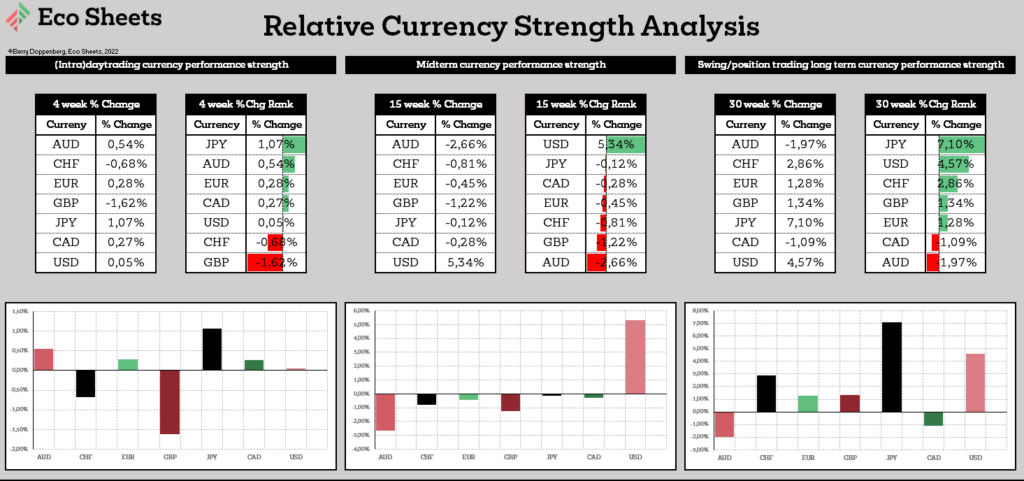
However, currently the exchange rate is only 2.35% from a triple top on the weekly/monthly timeframe, making many investors and traders scared to take this trade. Let’s look at my relative currency strength spreadsheet, to see a bigger picture. Over the past 30 and 15 weeks, the US dollar has outperformed the Canadian dollar very much. Only the past 4 weeks have shown that the Canadian dollar has gained a bit of strength. This implies a slowing uptrend and its price chart reflects that.
While both countries have lowered interest rates, they also show lower inflation. The US will keep their interest rates higher than that of Canada, opening up a carry trade opportunity for the longer term.
USD/CAD Projections
For those that are afraid of the multi-year triple top at around 1.468, it is possible that it is going to be hit during or even before march of this year. Monthly standard deviation is 2.15%, close to this triple top target of 2.35%. With tariffs threatening in February, USD/CAD might break that level even sooner. However, with monthly seasonality data, a projection for the end of 2025 is only 3.05% away. That is also what Trading Economics expects USD/CAD to show for this year.
Comments