
Your cart is currently empty!

recession
A Self Impoced Recession, Or Rightful Fears?
Key Highlights
- Is the fear of recession self-inflicted? – With the S&P 500 down almost 8%, are we pricing in a recession ourselves rather than reacting to economic reality?
- Trade war-driven uncertainty – The stock market is reacting heavily to headlines about a U.S. trade war, but 6 out of 9 economic indicators are not signaling a recession yet.
- Inflation risks and economic cycles – A trade war could fuel inflation, leading to higher interest rates, increased household debt, and potential job losses, mirroring past economic downturns.
- Investment strategies for uncertainty – Defensive stocks, precious metals, treasury bonds, and even short-selling weak companies can help protect capital during turbulent times.
- Personal approach to market volatility – Holding physical gold and silver, investing in stable insurance companies, and maintaining cash reserves for future opportunities.
Recently, I’ve seen and heard a lot about a possible upcoming recession. News headlines spread fear, and the stock market is suddenly pricing in a recession due to Trump’s trade war. The Dutch Central Planning Bureau (CPB) defines a recession as two or more consecutive quarters of economic downturn. However, the S&P 500 index is a leading indicator for future GDP growth (with a 6–12 month lag). The S&P 500 being down almost 8% from its high as we speak might indicate future negative GDP growth quarters. So, are we causing the recession ourselves?

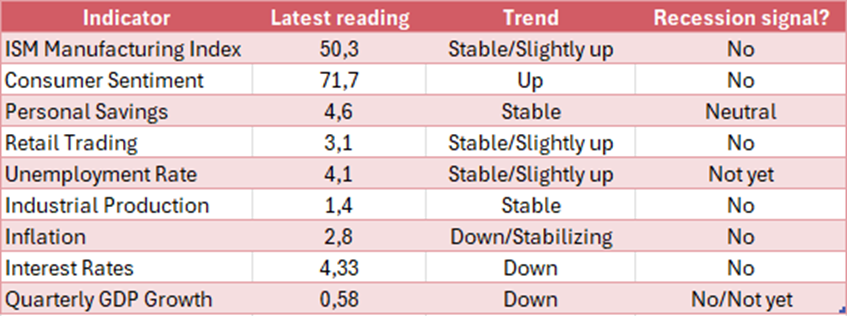
Let’s take a deeper look into what I’ve learned from other professional traders that can actually signal or define a recession. In the table below, you can read about the different indicators, their latest readings, their trends, and whether they signal a recession or not.
At the moment, the stock market is heavily influenced by headlines about a possible trade war, trade apocalypse, or (de-)escalating trade tariffs. The latest Bloomberg headline suggests that upcoming tariffs are more targeted than previously thought, giving index futures a reason to rally. As a result, the S&P 500 futures gapped up +0.4% overnight and are currently trading at +1.22% as of writing.
This is why, in my opinion, recession fears are solely based on a possible trade war between the U.S. and the rest of the world. A trade war can imply two things:
First, a trade war can trigger an upward trend in inflation. This is a very likely and concerning scenario. As inflation rises, the Federal Reserve (FED) might decide to keep rates unchanged or even increase them again, signaling a situation similar to the 1970s. Higher spending leads to more inflation. Wages rise to compensate for inflation, fueling it further. Loan costs increase alongside interest rates, putting more pressure on households. Companies might cut costs by laying off employees, leading to higher unemployment rates—and so on.
The second implication of a trade war is more extreme, inspired by Ray Dalio’s book The Changing World Order. As Trump initiates a trade war with the rest of the world, it could be a sign that he is trying to strengthen the U.S.’s global position. If the U.S. were not threatened in terms of world order (and reserve currency status), why would such measures be necessary? Possible threats include BRICS nations, or even Russia and China individually.
Let’s take a final look at the bigger—and more likely—picture. At the moment, six out of nine economic indicators are not pointing toward a recession. However, a full-blown trade war, as the headlines suggest, could change this quickly. The stock market is reacting to these headlines with extreme volatility and rapid movements.
How to Protect Your Capital Against a Recession Scenario*
*(No financial advice!)
Some investors suggest diversifying by putting money into ETFs. This way, your investments are spread across a basket of stocks rather than concentrated in individual ones. However, investing in an ETF only diversifies the number of companies you hold—it doesn’t necessarily diversify your money across different asset classes.
Stock-wise, defensive sectors like healthcare (hospitals, pharmaceutical companies) and insurance providers tend to outperform during recessions. These companies offer essential services that generate stable income regardless of economic conditions.
To protect capital against inflation, one might consider buying gold, silver, or other precious metals. These can be purchased either through the futures market or physically. If choosing physical metals, safety and storage measures should be taken into account.
A third option is treasury bonds. Bond prices move inversely to interest rates. If the FED cuts rates tomorrow, existing bonds with higher rates become more attractive, increasing their price. Conversely, if the FED hikes rates, demand for existing bonds drops, lowering their price.
A fourth option is cryptocurrency. However, in recent times, crypto has mostly been correlated with the stock market, meaning it tends to follow overall market movements rather than acting as a hedge.
A final option is short-selling stocks, particularly weak companies. Typically, during a recession, the overall stock market declines, and most individual stocks follow suit—except for a select few strong performers. Identifying companies with poor management or weak sales projections could present shorting opportunities.
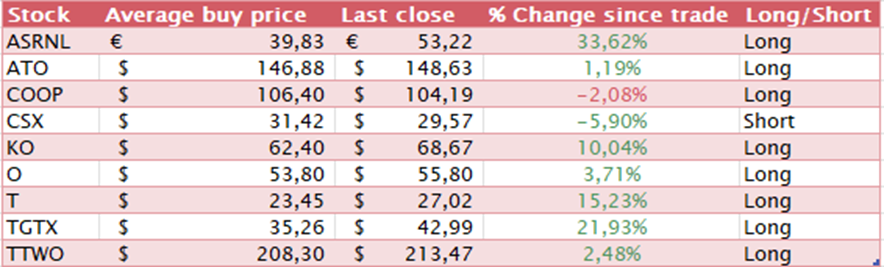
Currently, I own some physical gold and silver, I have invested in a mature, stable, and high-performing insurance company, and my stocks have outperformed the overall market over the past month. Additionally, I’m building cash reserves to invest in strong stocks once recession fears subside.
My current stock holdings
Comments